
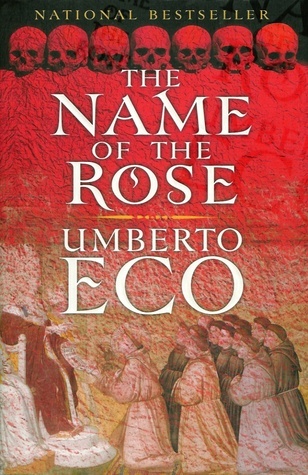
Happy Saturday! And welcome back to the final post of my very first buddy read with Emma @WordsandPeace, Mallika @LiteraryPoutpourri! For whoever followed our discussion and posts, I hope that we sparked your interest in picking up this amazing book and reading it for yourself!
Thank you both, Emma and Mallika, for this amazing experience and for choosing to include such a masterpiece in your buddy reads!
Here are the links to the previous posts of ours in case you have missed them our are curious to check them out:
- Opening (Mallika)
- Day 1 (Emma)
- Day 2 (Lin)
- Day 3 (Mallika)
- Day 4 (Emma)
- Day 5 (Lin)
- Day 6 (Mallika)
- Day 7 (Emma)
Last page:
Emma:
In my notes for the Seventh Day, I reflected on the meaning of the ekpyrosis.
And here, it’s specified that “The Abbey burned for three days and three nights”. Which I believe is a reference to death and Resurrection.
Same chaos in the world, with news that the emperor has chosen an antipope.
And the necessary separation of the two main characters, who will never meet again.
Purification by fire was needed for a rebirth. Though the fire here produces a world in which meaning must be rebuilt from fragments only, and that rebuilding is partial and fragile. It’s only the rebirth of possible interpretation (from the scraps found years later by Adso) after the death of certainty.
Though it seems Adso can only find the way of silence: “I shall fall into the silent and uninhabited divinity where there is no work and no image.”
And his final sentence, which gave the title to the novel:” stat rosa pristina nomine, nomina nuda tenemus” – the old rose stands only in its name; we hold only naked names.
In other words, after destruction, what we possess is not presence but names, traces, and meanings we reconstruct from them.
We are far from Dante’s rose, as a vision of perfect cosmic and spiritual arrangement.
Interestingly, from the scraps gathered, Adso manages to write a cento. A cento is like a patchwork poem made by stitching together lines or phrases borrowed from other texts.
Change only one letter, and you have a canto, and The Divine Comedy is made of cantos.
I’m sure this is not by chance, and I’ll write about this in my review post.
Mallika:
With a gothic setting, Eco also gives us a gothic ending which feels right out of Jane Eyre or Rebecca as the Abbey burns and continues to for three days and nights.
This state of affairs leaves its treasures open to both those in the abbey and those around (from the villages) with obvious consequences: looting of the treasures that they can manage.
Adso also tells us what unfolded in the future, as to Emperor Louis, Pope Jon XXII and also William. Louis had by that time been crowned in Rome and set up his own Pope only to lead to unspeakable tortures for those who supported John XXII. Then Louis is forced to retreat as Rome revolts and later his Popes surrenders to John XXII.
The two travel from one place to another, having to retreat or change direction because of unrest until they reach Munich. Here Adso we learn leaves him and returns to his abbey at Melk; but not before William advises him for his future studies and bids a warm farewell.
Years later, Adso visits the Abbey again to find not only the abbey in ruins but also the villages around deserted. The abbey however has left him a legacy, remnants of books that he painstakingly collects, and that go on to form for him a lesser library (a miniature of the abbey’s) and a course of study.
But he can’t but feel that this is chance rather than a specific message, as he had initially felt.
In his last days, he completes the manuscript but with no specific person to leave it to, no longer even sure of its purpose—convinced that it was these fragments that led him to write it as he did.
Lin:
Adso, writing near the end of his life, recalls the abbey burning for three days while villagers scavenged its remains. He and William escaped to Bobbio, where they learned of worsening political tensions involving the Emperor and an antipope. Seeing Italy as unsafe, William chose to go to Germany, and in Munich, the two parted warmly, with William gifting Adso a pair of glasses.
Years later, Adso revisits the abbey’s ruins, finding only fragments, like part of a carved image and scattered scraps from the destroyed library. He brings these manuscripts back to Melk but cannot piece together any clear meaning from them. In old age, he concludes that the past holds no discernible pattern or message. As he nears death, he accepts the idea of dissolving into a silent, formless divinity, leaving the reflection that only names remain while the original reality has vanished.
CONCLUDING THOUGHTS:
Mallika:
The Name of the Rose was indeed a rich read, with so many layers and themes: a mystery certainly but also a book that deep dove into philosophy, theology, semiotics, history and much else.
I certainly enjoyed the mystery element (which had also appealed to me the first time I read it) with its many twists and turns and the different possibilities and nuances ranging from illicit relationships to pure politics. One finds oneself considering all the possibilities but perhaps not quite guessing the reason that it ultimately turns out to be. Eventually, perhaps it was a traditional reason (power) that was the cause for all that unfolded and yet also in its own way unique.
I also especially enjoyed the question that the book goes into about what constitutes authentic knowledge. At the time of its setting, both religion and language defined and determined this, but the question itself is one relevant even today, when rather than limited knowledge, we have an abundance thanks to the internet and social media, once again bringing up the question of authenticity and trust. Perhaps, this is a question that emerges in every age in some form or other.
The historical aspects stood out to me as well—particularly the animosity between Emperor Louis and the Pope, the shift in centres of power, the decadence and corruption. As also the radical movements including those of Fra Dolcino and his band. And the undeniable truth that it is often the poor and simple that pay the price in these battles for power. Much of this as well as the politics playing out in the abbey itself drove home how–religious space or not–human nature doesn’t change very much and the same motivations, emotions, jealousies, and lust for power and control are always at play. Even if the motivations or goals claim to be noble, like the brutalities that took place under the banner of the inquisition, the outcomes and process can be equally condemnable.
The debate on the place of laughter was an interesting one: what makes such a basic human reaction taboo, or what made it so for those like Jorge? Is it at par with other kinds of abstinence that a religious/spiritual life calls for? Why so?; or is it also a device to critique, challenge and teach? ; this turned out to be an intriguing debate, with all its layers brought up by William and Jorge. The poverty of Christ debate was much easier to get one’s head around and one where the motivations were clearly to protect power, authority and wealth.
Some interesting observations on books and learning and our relationship/interaction with them also, I found interesting: ‘true learning must not be content with ideas, which are, in fact signs, but must discover things in their individual truth’.
‘books are not made to be believed, but to be subjected to inquiry’.
I could really go on and on with the many different aspects, including reasoning, new inventions of the time, and much else, but I will stop here just saying how all of these added so much to the book that had one thinking all the time. I’m so happy I read it with you Emma, who had so much additional information for us which made things clearer and helped us get so much context, and you Lin for bringing in your perspectives, especially your personal connection with this being one of your grandma’s favourites.
For me, if I had one criticism, it was possibly that since the mystery thread was the central one in the book, at times some of the digressions into other areas perhaps felt too long, even if I enjoyed them in themselves. I particularly felt this when Adso looks up the symptoms of being in love!
I was happy to unpack so many layers of this book on this reading (definitely no easy one) though I feel there’s still much I didn’t entirely take in.
Thank you once again, Emma and Lin for being part of this buddy read!
Emma:
Wow, rereading this book several decades after the first time I discovered it was quite an adventure!
At the time, I probably focused mostly on the mystery elements, which after all may not be that central, but more like the vehicle.
I think the important layers here are all the theological and political debates of the time, and at the center of the rose (ah ah) I see the question of interpretation, or of its instability.
Eco keeps showing that every sign can be read in more than one way, and that the desire for a final, totalizing explanation can become dangerous. So for me, the novel’s detective structure matters less as a puzzle to solve than as a demonstration of how meaning is constructed, mistaken, and contested.
I’m glad I had the opportunity to revisit this book, which years ago, I probably never really understood. And having to read it very closely to share with my buddyreaders was really essential to reach a deeper reading, so thanks for sharing the adventure, Mallika and Lin, and thanks for pointing out elements I would not have seen by myself.
My edition came with a fascinating Postscript, by Umberto Eco himself – I will share more about it in my review post.
I would just like to highlight here the very last part of it, called Ending:
“It seems that the Parisian Oulipo group has recently constructed a matrix of all possible murder-story situations and has found that there is still to be written a book in which the murderer is the reader.
Moral: there exist obsessive ideas, they are never personal; books talk among themselves, and any true detection should prove that we are the guilty party.”
So I’m wondering, does our desire for order, when we read what we think at first is a mystery, can help produce the very nightmare we think we are only uncovering?
Are we the real killer in the story?
Lin:
I totally agree with you, Mallika. There were so many layers to this book and themes that it was never boring.
I did find that the historical aspect was probably the most fascinating part, and I thoroughly enjoyed reading how the author managed to incorporate so many different themes. This was a special book to me, and I am very happy to say that it surprised me.
And absolutely, Emma, I felt the same, the layer about theology and politics was very prominent and definitely the centre of the rose! (I see what you did there haha) I loved that Eco did a lot of research and he definitely managed to transport his readers into the era he was writing about.
The mystery elements were engaging, and I liked that you were not given the answers easily. You had to investigate with Adso and William to unravel everything that was going on, and most importantly, why!
Additionally, there were so many thought-provoking passages, and one could go on a philosophical tangent and go down a rabbit hole, in a good way. Very pleased and surprised by this book, indeed!
Overall, an amazing read that I am so thankful I had the opportunity to experience it with both of you, so thank you, Mallika and Emma, and I really hope I will be able to join in another buddy read with you two.
I wish you all happy reading and a very blessed weekend!







Leave a Reply