
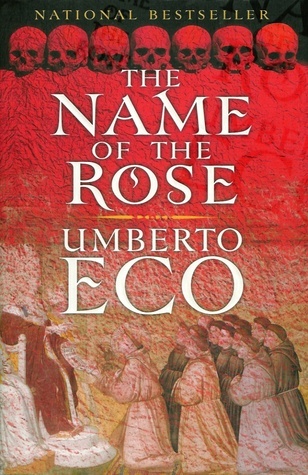
Welcome back to our buddy read discussion about The Name of the Rose by Umberto Eco. We are now venturing into the 5th day of the adventure of William and Adso, and we are about to find out what the development is with the murders and the library.
The story is getting more interesting and more complicated by the day, and we are all here for it!
Here are the links to the previous days in case you are interested in following the whole discussion of Emma @WordsandPeace, Mallika @LiteraryPoutpourri and me:
Prime
Emma:
The fog is very thick in that region apparently. It adds a nice note of mystery and spookiness.
And Adso does feel more mystery around Malachi and Bernard Gui.
We have here more beautiful descriptions of monastic architecture, this time the chapter room. Well, usually it’s a room, but here it seems to be a separate building, the chapter house. It’s called chapter room/house, because monks meet there every day, traditionally after Mass I believe, to listen to the reading of a chapter of the Rule of Saint Benedict and to a commentary of the abbot on it.
Again, there’s a description of the tympanum (see the picture of the Conques tympanum in First Day).
I think it would have been very rare to have a tympanum over a chapter room door, but maybe it existed in very rich monasteries. There’s a famous one in Southwell Minster, UK, but this was a cathedral, not a monastery.
However, many chapter houses had gorgeous columns and capitals. You can see beautiful examples here, in a 12th century French monastery).
The tympanum described in this chapter has another long list of weird types of creatures, like the ones we mentioned in illuminations (see First Day). It could have been a way of representing the whole cosmos:
“These and other wonders were carved on that doorway. But none of them caused uneasiness because they did not signify the evils of this earth or the torments of hell but, rather, bore witness that the Word had reached all the known world and was extending to the unknown; thus the doorway was a joyous promise of splendid oecumen.”
We are provided, through the abbot’s mouth, with a summary of the whole political and religious situation at stake.
One important element is highlighted, as for poverty: poverty at the individual level, and poverty at the institutional level. And that was a major source of debate indeed in the Franciscan order after the death of Francis. One argument, illustrated through the person of Christ, is that:
“Christ as a mortal man, from the moment of his conception, was owner of all earthly goods, and as God he received from the Father universal control over everything; he was owner of clothing, food, money for tribute, and offerings of the faithful; and if he was poor, it was not because he had no property, but because he did not receive its fruits”.
This is a complex debate. No wonder this chapter house discussion ended up in shouts, insults, a brawl, and the necessity for the archers to intervene to prevent more violence.
Sad to say, some similar scenes did happen (including in very recent history) during councils, gathering Christian bishops from many countries, including physical violence.
Lin:
This was indeed a complex and heated debate. This is something that, unfortunately, will continue to happen because the church is infiltrated (and not only, I am talking about politics, even our very persons, friends, family and colleagues…), and there is a saying that always makes me stop dead in my tracks: “Even the devil can quote Scripture”. This saying is based on James 2:19, and it emphasises that mere knowledge of God or memorisation of the Bible is not the same as having saving faith, obedience, or true transformation. Goes without saying that this book could be the representation of this very phrase. We have murders in holy grounds, performed by supposedly holy people, and it doesn’t take a genius to notice that something very sinister and evil is going on under the surface.
The day of the meeting arrives, and on his way to the chapter house, Adso notices Bernard Gui and Malachi parting ways, with Malachi behaving suspiciously. The gathering between the Franciscans and the Avignon delegation begins, centred on the debate over Franciscan poverty. What starts as a formal discussion quickly escalates into a heated argument, with both sides shouting and tensions rising. Amid the disorder, William confides to Adso that he is in a difficult position, unsure how he would respond if called upon to speak. As the situation threatens to spiral out of control, Gui orders the archers to step in and physically separate the opposing sides, restoring order by force.
Mallika:
Adso is naturally worried about the girl only to be woken by William and reminded that this is the day of the meeting of the two delegations—the day doesn’t forebode well with vague shapes, shadows and apparitions seeming to appear all around the abbey—at least in Adso’s eyes.
We also see some fishy perhaps between Bernard Gui and Malachi the librarian—but what?
Adso enters the Chapter Hall, built over the former church, which also has an elaborate tympanum—beautiful and not as disturbing than the new one. It’s interesting how fantastical figures decorate these too—are they somehow acceptable here but not in books? Adso feels guilt over bewailing his ‘small’ problems when much larger ones prevail.
The legations at least formally aim to ‘settle fraternally the dispute’ and the debate begins—once again bringing up the poverty or not of Christ—the issue on which they are at odds. Ubertino’s speech demonstrates his clear and consequential reasoning and abilities as a speaker/preacher but soon enough the debate spirals into a verbal and then almost physical brawl.
Terce
Mallika:
Meanwhile there are developments as regards the murders too as Severinus comes to inform William of something he has found and the latter must urgently see. But William has to be present at the meeting and sends Severinus back advising precautions—but will these suffice? William begins his own address with ideas that certainly seemed ahead of his time—but when I looked it I did find that the two swords (temporal and spiritual) theory did go back much further—in fact as far back as the 5th century, though it seems by William’s time, the Pope had all but forgotten this and wished to assert his power in both realms. Ideas of democracy too did prevail (which I against didn’t realise) but perhaps not seen always as positively as in the present or further back in the past.
Some of the debate, in the previous segment and this was difficult to get my head around but I did like William’s approach in terms of showing not whether Christ was or wasn’t poor but that he coveted no riches/material wealth or even command.
Emma:
Severinus comes to tell William he found a strange book in his laboratory. At this point, William doesn’t get any detail on why Severinus finds this book strange, and this missing element will make their investigation and search more complicated afterwards (see Sext below).
But Jorge is lurking around – he is always lurking. Ados is asked to follow him, but then the cellarer shows up and he decides to follow him instead.
Lin:
During the heated quarrel, a novice quietly informs William that Severinus urgently needs to speak with him. When they meet, Severinus explains that Berengar must have visited the infirmary before going to the baths, as he has discovered a strange book in his laboratory. As he begins to insist that William come see it, Jorge suddenly appears beside them.
At that moment, Michael calls William back to the meeting. Before leaving, William instructs Severinus to return to the lab, lock himself inside, and safeguard the book. He also tells Adso to follow Jorge. As William departs, he notices Aymaro slipping out after Jorge and loudly warns Severinus to protect the papers and not to return them to where they came from. Remigio overhears this and begins following Severinus as well.
Seeing that Jorge appears to be heading toward the Aedificium, Adso instead chooses to follow Remigio, who goes toward the infirmary. In the thick fog, Adso loses track of Aymaro but sees that the infirmary door is closed, with Remigio still outside. Realising he is being watched, Remigio turns away and heads toward the kitchen.
In the meeting, William presents a strong argument that the Church should serve God alone and avoid entanglement with worldly power, insisting that Christ himself embraced poverty. His reasoning is compelling enough to silence the room until the Cardinal coldly responds that the Pope would be displeased by such views.
At that point, Bernard Gui interrupts the proceedings, announcing that the meeting must be suspended due to a grave new development. William quietly tells Adso that he fears the news concerns Severinus.
Sext
Emma:
The laboratory is in disarray, obviously someone came in to find something. Severinus is dead.
We discover more secrets, now between Remigio and Malachi.
Is someone playing all these monks against each other? Who, and for what reasons? Just ideological reasons, or more?
Benno explains what and whom he saw. But he could also be lying.
But William knows there was indeed a special book in the infirmary (the book Severinus just talked to him about), and it seems nowhere to be seen now. But how do you really look for a book when you don’t really know what type of book it is?
Adso tries to help to find it, and he gets a good rebuke:
“Thesaurus herbarum,” I said, and William snapped, “Drop it; we’re looking for a Greek book!”
“This?” I asked, showing him a work whose pages were covered with abstruse letters. And William said, “No, that’s Arabic, idiot! Bacon was right: the scholar’s first duty is to learn languages!”
“But you don’t know Arabic, either!” I replied, irked, to which William answered, “At least I understand when it is Arabic!” And I blushed, because I could hear Benno snickering behind my back.”
Then he even gets insults, as he only looked at the first pages of the book – at the time, it was not unusual to have several books bound together. So one could have started in Arabic and have indeed a Greek book bound to it. An essential detail Adso overlooked:
“William roughly dragged me out of the narthex and sent me running toward the infirmary. “You Teuton animal, you turnip! You ignoramus! You looked only at the first pages and not at the rest!”
So now they have to go back and try to find it again.
Too late…
At the end of this section, we know Benno took the book. Will he be the next on the list of murdered monks?
With this fifth murder, and the weapon used, we have a confirmation of the plan following the Book of the Apocalypse/Revelation.
Mallika:
The debate is interrupted by a gruesome find—not unsurprising given the events earlier in the day—Severinus is found dead—murdered; the book he spoke to William of seems missing, and Remigio the cellarer, seen to have entered the laboratory taken into custody by Bernard Gui.
Benno informs William that Malachi was already inside and it is unlikely that Remigio was the murderer—William examines all the books in the room but is unable to find what he is looking for, or so it seems. This turns into a narrow miss for by the time it strikes them, the book is again gone. They do catch on to a link though, the book of John the Apostle and the manner in which the murders have been committed. Here I could see shades of Christie, in books like The Patriotic Murders or A Pocket Full of Ryewhere a rhyme or book provides the template for how the murders are presented.
Lin:
A group arrives at the infirmary and discovers Severinus lying dead in a pool of blood, his head smashed, and the room in complete disarray. The archers have already taken Remigio into custody, explaining that while searching for him, Alinardo reported seeing him heading toward the infirmary. When they found him, Remigio was rummaging through the shelves, apparently searching for something, while Severinus’s body lay nearby.
William observes that Severinus is still wearing gloves, suggesting he has no black stains on his fingers like the previous victims. As the guards drag Remigio away, Malachi appears, and Remigio grabs him, shouting, “You swear, and I swear!” Malachi calmly responds that he will do nothing to harm him. At this point, Benno adds that he never saw Malachi enter the infirmary, implying he must have already been inside before Remigio arrived.
William and Adso clear the room, leaving Benno at the door, and search for the mysterious book, but fail to find it. They eventually allow the other monks to enter and tend to Severinus’s body.
Later, reflecting on Severinus’s description of the book as “strange,” they realise they may have overlooked it. Returning to the lab, they discover that one of the books is now missing. Benno becomes the main suspect, but they dismiss the idea that he would have taken it back to his cell, and instead decide to return to the chapter house.
Adso hints, however, that even more dramatic and troubling events are about to unfold before they get there.
Nones
Emma:
Back in the chapter house, now to interrogate Remigio and Salvatore, then Malachi is brought in. It’s actually a real scene of Inquisition, with focus more on heresies and their past links with heretics, than on the murders themselves.
Could the secret document only be letters by Fra Dolcino, brought back by the monk and hidden in a secret place of the library?
To avoid being dragged into this, William makes up a fine lie about an Arabic manuscript on canine hydrophobia! With a hilarious play on words, as canis is a dog in latin, and a fun popular etymology of the Dominicans (Bernard Gui is one) is Domini canes – the Lord’s dogs.
As common with the Inquisition, the cellarer is led to a trap and to confess – he agrees to confess whatever they want, but does insist he is not a murderer.
At the prospect of being tortured, he recounts the scene of Fra Dolcino’s torture he witnessed ear;ier in his life. To avoid going through the same thing, he confesses to killing the monks. Though it’s obviously clear this is all made up.
Bernard doesn’t care if it’s true or not, the murders in the monastery do not concern him, he caught a heretic and is happy with that.
Lin:
Bernard Gui begins interrogating Remigio on charges of murder and heresy. Remigio initially avoids answering questions about his past, but the situation shifts when Salvatore, clearly tortured, is brought in. Under pressure, Salvatore reveals that Remigio had once been part of Fra Dolcino’s group, carrying letters for him and later entrusting them to Malachi, who hid them in a secret room in the library.
Faced with this, Remigio finally admits his past involvement with Dolcino and confesses to committing terrible acts, but he continues to deny any role in the recent murders at the abbey. However, when Bernard threatens him with torture, Remigio breaks. In a frantic and incoherent speech, he agrees to confess to whatever Bernard wants and ultimately claims responsibility for the murders before collapsing in exhaustion.
As the trial concludes, Bernard outlines the various types of heretics and their supporters, pointedly directing his remarks toward Ubertino.
Mallika:
Meanwhile Remigio’s interrogation by Gui begins as William explains to Adso how an inquisitor is not only exempt from ordinary rules, he needn’t even listen to lawyers. Not only that, more cruelly, he uses every instrument of torture without ever getting his own hands dirty, thus maintaining the appearance of holiness and right conduct.
Here Gui already applies mental torture as a start—using silence and delay, and then on only builds the pressure until Remigio can do nothing but incriminate himself, and is in fact driven so far over edge that he confesses to everything, even what he hasn’t done. But this is unfortunately not going to spare him torture, and that of the worst kind. Salvatore has given him up as has Malachi!
Vespers
Lin:
With it now clear that no agreement will be reached, Michael declares that he will still go to Avignon and is willing to compromise on every issue except poverty, even if it puts his life at risk. William warns that, given Bernard Gui’s statements and the Pope’s hostility, Ubertino is also in danger and must flee immediately. With the Abbot’s help, Ubertino escapes the abbey under the cover of fog.
Turning back to the murders, William questions Benno about the missing book. Benno claims he cannot speak freely by order of the Abbot, who has just appointed him assistant librarian, but he does admit that he took the book earlier that day and later handed it over to Malachi. Afterwards, William explains to Adso that Benno is driven by a desire for knowledge purely for its own sake, not for any practical or moral purpose.
As they leave the kitchen, Aymaro approaches and asks whether the rumour about Benno’s appointment is true. When it is confirmed, he bitterly remarks that if justice truly existed, the Devil would come for Malachi that very night.
Mallika:
We’re given some more insight into what Micheal of Cessna will do in the future, taking a position very different from what he has been so far but then he has said as much that his only goal was to be accepted into the Pope’s fold. For the present he heeds no warning and is set on going to Avignon where John XXII is based.
William fears for Ubertino’s safety and bids him to leave—and this does save him for the present.
Alongside, he reflects on the lusts that have taken possession of the different persons involved—not all the same kind but affecting them in the same way—that for knowledge in Benno, in a distorted form for justice in Bernard Gui, and for wealth in the Pope. Aymaro reflects on how justice out to have played out had it existed!
Emma:
Ubertino is a leading Spiritual Franciscan, the rigorist wing that insists on absolute poverty and condemns the wealth of the Church. He is in exile and only survives because the abbey secretly shelters him. After this Inquisition scene, William knows that Ubertino will be next on Gui’s list. Remaining at the abbey means likely arrest, torture, and execution, so flight is the only realistic way to preserve his life. Following William’s advice, he decides to flee.
The end of this section seems to announce the next murder!
Compline
Emma:
Oh oh, the abbot decides not to speak today, but to leave his place to Jorge. It seems to confirm my suspicions of both. Through his strong admonition, he seems to be revealing his true colors, and his narrow understanding of knowledge. And he quotes the Book of Revelation, and what happens on the seven days. Is he the (only) murderer?
Another long list, this time of all types of lawlessness, signs of the time of the Antichrist.
There’s another Biblical reference, also connected to eschatology:
“To each I shall give what he deserves. I would have mercy on you, but I find no oil in your jars. I would be impelled to take pity, but your lamps are not cleaned. Go from me. . . . Thus will speak the Lord.”
This is based on the parable of the wise and foolish virgins in Matthew 25:1-13: people must be genuinely prepared for Christ’s coming. Last‑minute and superficial readiness cannot substitute for a life of faithful discipleship.
Lin:
It does feel like we are living in the end times, and this biblical reference does resonate with me.
Emma:
In the context of the Inquisition, William says the Inquisitor Jacques Fournier has higher ambitions. Indeed he had. First a Cistercian monk, he became bishop of Pamiers. As such, he was known for his rigorous inquisitorial campaigns against remaining Cathars in the early 14th century, conducting detailed interrogations and trials that left a rich documentary record. And then he became pope, under the name Benedict XII (Avignon papacy, not Roman).
Mallika:
At Compline, the Abbot prefers to keep silence than speak and Alinardo is in no position to do so. The sermon is delivered by Jorge who delivers a fiery discourse on the authenticity of knowledge and extent to which he believes it ought to be pursued both in the Abbey and the wider world. He feels the Abbey’s function is simply to meditate, gloss and preserve, not to seek. The sermon goes on to describe the coming of not one but many forms of the Anti-Christ, many elements of which reminded me of the idea of Kali Yuga, one of the ages in the Hindu cycle which to brings to an end the cycles of the world and where similar situations of conflict, depravity, and immorality prevail. His description, including the ‘climate change’ aspects are also very reminiscent of the present.William manages to lighten the mood for Adso, who realises in despair how it is indeed the simple who end up paying the price, for even those who have driven/incited them to rebel.
Lin:
The Abbot, overwhelmed by the day’s events, declines to speak at compline and asks Jorge to deliver the sermon instead. Jorge warns the monks that the monastery exists to preserve knowledge, not to pursue it, since the ultimate truth is already contained in the Bible. He argues that the abbey’s troubles are a punishment for intellectual pride and goes on to describe the coming of the Antichrist and the signs of the Apocalypse.
After the service, William and Adso discuss the likely fate of the prisoners. William predicts that Remigio will be executed, his death serving as a political message during Michael’s dealings with the Pope. He believes Salvatore may be spared, as he holds little value to Bernard Gui, but the peasant girl will almost certainly be burned as a witch.
Adso is deeply shaken by this, feeling both grief and guilt, as he believes he shares responsibility for her fate after their encounter.
Thank you both, Emma and Mallika, and thank you to anyone who has stopped by and read this post.
Expect the next posts on these dates in case you would like to follow our discussion:
- 14th April (Mallika Day 6)
- 16th April (Emma Day 7)
- 18th April (Lin Last page and final thoughts)


 Lin's Perspective
Leave a comment