
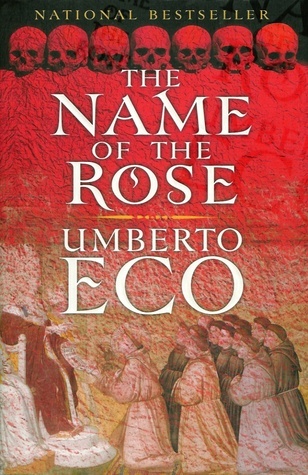
Synopsis:
The year is 1327. Franciscans in a wealthy Italian abbey are suspected of heresy, and Brother William of Baskerville arrives to investigate. When his delicate mission is suddenly overshadowed by seven bizarre deaths, Brother William turns to the logic of Aristotle, the theology of Aquinas, and the empirical insights of Roger Bacon to find the killer. He collects evidence, deciphers secret symbols and coded manuscripts, and digs into the eerie labyrinth of the abbey (“where the most interesting things happen at night”) armed with a wry sense of humor and a ferocious curiosity.
- Pages: 561
- Genre: Historical fiction, Mystery, Classics
- Publication date: First published September 1, 1980
- Format: Paperback, Kindle, Hardcover, Audiobook
- Source: Owned
This is my very first buddy read, and I am so glad to be doing it with Emma @Words and Peace, and Mallika @Literary Potpourri! Being a long and hefty book, we all had a lot to say and discuss. Today, I will be covering the Second Day of our adventure in the story. If you would like to catch up with the previous chapters and discussion, here are the links to my fellow buddy readers’ posts: Mallika Naturally a Manuscript, and Prologue, and Emma First Day.
Without further ado let’s dive into the second day:
Second day Matins:
Emma:
We have now a detailed and accurate description of the first prayer service of the day.
But Adso interprets the passage of the Rule read that day as another bad omen! Indeed, the service is interrupted as workers come to announce they have found a dead man – the second.
Now it’s surprising that all the monks leave church. Prayer services are called the Opus Dei, the Work of God, so usually when something happens, only the abbot, the prior, the cellarer and if needed a few other monks leave, but the others do continue the prayer – especially in a big abbey as this one with about 60 monks. Definitely not a good place to be for a monk!
The victim this time is monk Venantius, a translator, so again a monk who used to work in the scriptorium, and had maybe access to the library.
Now we are discovering the infirmary, with its impressive collections of remedies… and poisons!
Lin:
Before dawn, during Matins, the monastery is shaken by the discovery of another death—Venantius is found dead in a vat of pig’s blood. This shocking event deepens the mystery surrounding Adelmo’s earlier death and raises fears that something sinister is unfolding within the abbey.
William begins a more active investigation, examining Venantius’s body and the scene carefully. He notes clues that suggest the deaths may be connected and not accidental. The secrecy of the library becomes even more suspicious, especially since Venantius had been a translator with access to rare texts.
As fear spreads among the monks, some begin to interpret the deaths as signs of divine punishment or apocalyptic warnings. William, however, rejects these explanations and continues to rely on logic and observation, setting up a growing conflict between rational inquiry and religious superstition. William makes several observations, such as Venantius fingers and tongue are darkened almost black, the strange marks on his body and that the corpse seems to be moved after death. He starts to form possible causes: poison, hidden struggle and a secret meeting gone wrong.
Mallika:
Early hours, when, at least in winter, even the rooster cannot be relied on to crow
Between matins and lauds, we see the monks studying the psalms and tend to the church ornaments.
Adso is unsettled by the thought that the wicked have no fear of even God. And now a second death is discovered, this time surely murder from the manner in which the body is found.
We are reminded of the season for the third time, as snow serves as a parchment which can yield many clues, but not here it seems—footprints between the jar and the Aedifcium means he likely died in the library—and the murderer wished for the body to be found!
Poison? They can be healthful or harmful based on the dose and Severinus’ lab has many—mandragora, borage… after all, even the Greek work pharmakon could mean both poison and medicine. And then there’s mention of hallucinogens!
Lin:
The mystery definitely deepens on the second day. And now we are all certain that the death of Adelmo was not due to suicide, but there is something more sinister going on in the grounds of the abbey. I can see that we are getting excited by the events and would like to find out more about why these bodies are coming up and what is actually going on!
Prime:
Lin:
After the discovery of Venantius’s death, the monks gather in a tense and fearful atmosphere. The abbot becomes increasingly concerned about the reputation of the monastery, especially with important visitors expected. He urges discretion and wants to avoid scandal, while still allowing William of Baskerville to continue investigating.
William begins connecting the two deaths, suspecting they are linked rather than coincidental. He questions the monks and pays close attention to their behaviour, noticing unease and secrecy—particularly around those connected to the library.
Mallika:
We can see the monks are now shaken by all that has taken place. Berengar in particular looks pale, drawn—clearly frightened while Benno seems nervous. William acknowledges the difficulty of their task: a hard task that of the inquisitor who must strike the weakest and at their moment of greatest weakness.
Benno seems in a hurry to get away but they speak to him of the discussions of the previous day. The stern and rigid Jorge believes that poetry is infirma doctrina (weak doctrine) being fragmentary but is accepting of the psalms as works of divine inspiration using metaphor to convey the truth—does not all poetry do much the name, it’s impossible to convince Jorge.
Meanwhile it is emphasized how deeply these monks’ lives are governed by and lived in and amidst books: ‘among books, with books, from books’.
Emma:
At church after that, William and Adso observe the monks, trying to guess who looks most suspicious and guilty. A lot of them seem to be!
At least William seems to think books are what connects both deaths, and possibly to Berengar, the assistant librarian. But why?
It is in the following conversation that Jorge contradicts himself and shows that he did remember a conversation that earlier on he had claimed he had forgotten. What was so important in that conversation? Why was he lying?
We also discover a dramatic conversation between Adelmo and Berengar shortly before the former’s death.
Berengar is totally scared and wants to confess something to William. But William doesn’t accept, because if he hears something during confession, he is not supposed to reveal it to anyone, and so his investigation would be dead in the water.
Anyhow, things seem to become clear to William. But like Sherlock Holmes, he doesn’t explain what, and Adso has no clue, just like Watson.
Lin:
The restricted nature of the library becomes even more significant, hinting that it may hold answers. He learns that Venantius had been studying and translating a Greek manuscript, which was a rare skill. This character was interested in ancient philosophers, including Aristotle. William finds out that Venantius might have been entering the library, secretly searching for particular books.
Mallika:
The discussion had turned again to laughter which Venantius believed was something good and an instrument of truth (based on the missing part of Aristotle’s poetics)—while Jorge feels the fact it hasn’t been found evidences its frivolity.
William ponders the reactions of the monks—Malachi’s anger, Benno’s direction (or misdirection?)—but William is still keen to enter the library.
Berengar speaks of his strange meeting with Adelmo before his death, and his unusual behaviour, almost like haunted by someone or something. He knows more but wants to protect himself—only willing to tell all under confession. William wonders about whether the visions are a result of being buried in books too much—he is now fairly sure of what happened to Adelmo and Berengar’s possible role or involvement. Adso raises the relevant point, don’t all of us believe in a God of mercy?
And with this comes another important point, and one that’s seen across cultures and faiths—the use of fear/terror to stimulate piety and obedience—and something that’s done successfully, tough it is so contrary to the basic idea of the divine everywhere, that the divine is an instrument of love.
This element of fear is also related to another facet, the understanding and practice of penitence, and this is where Fra Dolcino (1250-1307) who established the Dulcinian movement also comes in—they may have been inspired by Joachim and Franciscan ideals but took to pillage and murder. Here were see the fissure between ideal and practice (don’t we see that everywhere—look at communism).
Lin:
I totally agree that fear plays a huge role here and we see that to an extent it works to keep the monks away from the library for the most part. But for some curiosity or perhaps the thirst to gain knowledge overpowered the fear.
Terce:
Lin:
William and Adso witness tension in the abbey: Salvatore argues with the cook, who accuses him of improper behaviour, while Salvatore insists he is not a heretic. Another monk, Aymaro, hints at deeper unrest, suggesting some monks might have preferred a different victim than Adelmo and warning of strange, possibly hallucinatory effects at night in the abbey.
Mallika:
We see Salvatore passing on some chicken from the kitchens to the herdsmen, incurring wrath.
Self-flagellation as penance: also common to so many faiths—but is that really penance?
Adso begins to wonder whether William has lost the power of discernment (and the assistance of the Lord) for he can’t quite see the sense of what he says.
Meanwhile we also meet Aymaro who not only gives some cryptic hints and also brings up more points of conflict simmering in the abbey—not all (including himself) are happy with the Abbot’s leadership and way of managing both Abbey and library—questions of Italians versus outsiders and the role or need for commerce (in this new and changed world) come up.
Yes, there must be adaptation but one has to wonder that surely ones who are spiritual like monks have to be above these questions: shouldn’t they be treating all men as brothers, shouldn’t they be above avarice? Yes, even an abbey is as much about power and politics as the wider world.
Back in the Scriptorium, William and Jorge continue to debate the role of laughter—does it really turn humans into something else? Perhaps the question that needs to be considered is how far human traits need to be controlled and expressed, and whether mere expression makes one less pious or more frivolous? The debate is heated, many sources are cited, but William eventually adopts the route of humility, after all he is there to investigate a crime.
There is something in Venantius’ desk and he needs to find it.
Lin:
In the scriptorium, they investigate Venantius’s work, learning he had been translating a Greek text. A philosophical debate—especially about truth and laughter—breaks out, led by Jorge.
This debate was quite intense and really thought-provoking. As you mentioned, Mallika, does it really turn humans into something else, and is it as evil as Jorger believes it to be? Does it divert us from the righteous path and only take us further away from God? There is so much to unpack on this debate, per se!
Afterwards, Benno urgently asks to meet William in secret, and William ensures Venantius’s desk is guarded before leaving, suggesting concern about tampering or hidden information.
Emma:
We read here some hilarious Medieval swear words! Through some, we discover for sure some immoral relationships in that monastery – definitely not common!
A monk refers to offering poisoned wine to get rid of an undesirable abbot. This is actually a well known reference to a passage in the life of Saint Benedict. He was sent to amend the life in an abbey, and the jealous monks offered him a goblet containing wine and poison. But he made the sign of the cross over it, causing the cup to shatter miraculously, saving his life.
Jealousy could indeed also be at stake here in this monastery, within the context of the struggle between the Pope and the Emperor, and the various groups of religious, supporting one or the other.
William is warned to be careful by night, and of special bad herbs used then. Are these drugs? Special incense?
We are back to a discussion on laughter (the reference to the Rule of Saint Benedict is correct), with Jorge. He seems to be quite extreme.
William wants time to examine Venantius’s desk, sure he can find clues to his death there, but the monks seem to try always to distract him from this task. What message could be hidden there?
Lin:
Yes, there were some funny swear words! Now that you have mentioned it, I do recall a few that stuck with me: “Perverter of meaning,” which basically means someone twisting the truth, and “Ignoramus”, the equivalent of someone unworthy of knowledge, not simply someone being obtuse! I think I might adopt them into my everyday vocabulary…
What message could be hidden there, indeed!
Sext:
Emma:
We are discovering another part of the abbey, the treasure of their many sacred vessels. This is definitely a rich monastery. It makes sense then in that context to find a reference to Abbot Suger (1081–1151). He was a French abbot and Gothic architecture pioneer. As abbot of Saint-Denis, he rebuilt the royal abbey church near Paris with lots of luxury. His style is often contrasted to the Cistercian simplicity.
More details about the relationships of power and pressure between Franciscans, the Pope, and the Emperor.
The author warns us ahead that there’s going to be a third crime! Forget the suspense.
Time is pressing for William to discover what’s going on, before the arrival of the papal legation!
I mentioned earlier on that the English translator uses Nones whereas in modern monastic usage we say None. I think there’s a similar problem with Catharists. I was a bit confused and had to check if they were really what I thought. Indeed, they are usually called Cathars. Anyway, another example of heretics.
I also found it weird to see Arnald Almalaricus (known in English as Arnaud Amalric or Arnaud Amaury) designated as Bishop of Citeaux.
Citeaux is the first Cistercian monastery founded in 1098. Its head is an abbot, not a bishop. Indeed, later on in life Arnaud was appointed bishop, but of the diocese of Narbonne, obviously not a monastery.
So I went to check the original text in Italian, because it really didn’t make any sense to me that Eco would say that. Guess what, in Italian it’s “Arnaldo Amalrico, abate di Citeaux”. Definitely abbot!
Also, not sure why the translator used the Latin form, when Eco used the Italian Arnaldo. Maybe at this point, the translator was already tired of checking every name for their English spelling, if he didn’t know them! I still have a good knowledge of Cistercian history, so I happened to know that guy.
It seems more and more important that to solve the investigation, William has to dig deeper in the monks’ previous life: “Do you believe that the source of the recent events can be found in some obscure story dating back to the heretical past of one of the monks?” But the big question of course is, which one(s)?
Lin:
I think this chapter was the most shocking one for me thus far due to what is suggested here. Benno tells William and Adso that Berengar had a sexual arrangement with Adelmo, offering him a secret, likely related to forbidden knowledge, in exchange. Could this be true? Or is it simply a distraction from what the actual truth might be?
On the night Adelmo died, Benno secretly followed him: Adelmo met Berengar, then fled his room, went to Jorge’s cell (likely to confess), and later to the church, while Berengar and even Venantius watched from a distance. Adelmo was found dead the next day.
William notes the story mostly matches Berengar’s earlier account and begins forming a timeline and possible motives. He and Adso then plan to investigate the library that night after meeting the abbot.
Emma:
At the very end of this part, Adso prays the following as he falls asleep, though it’s the afternoon: “Salva me ab ore leonis”. It is the Latin for “Deliver me from the mouth of the lion,” a direct quote from Psalm 22:21 (Vulgate numbering; Psalm 21:22 in Hebrew).
What’s interesting is that still today, some Cistercian monasteries use another Scriptural verse with the image of the lion, at Compline, right before going to bed: “Your adversary the devil prowls around like a roaring lion, seeking someone to devour” (1 Peter 5:8). Both refer to the devil as the lion.
I think there’s an allusion to this quotation in fact shortly after in the next part, when monk Alinardo says “The beast is roaming about the abbey”, combining the image of the lion with that of the beast of the Book of Revelation.
By the way, this quasi obsession on the Book of Revelation/The Apocalypse in this novel is in keeping with the historical context. It was indeed prominent in medieval monastic life, especially from the 10th-13th centuries, through illustrated manuscripts, commentaries, and some liturgical readings.
It was so because you can interpret many of its verses with an eschatological slant. Eschatology in simple words is the study of “last things”: death, judgment, heaven and hell, and the end of the world.
Lin:
Thank you, Emma, for all the detailed information you provide! This is such a huge help for me to get more out of the story and actually understand it more. As mentioned before, this is not an easy book, and there are so many layers hidden in it that one must read between the lines to grasp the full meaning!
Mallika:
Benno seems to have told the truth but only fragments of a whole, and seems also to be using his knowledge to gain his own ends—transparency in the running of the library. We learn what Beranger may have done. But was the reason Benno attributes enough?
William’s advice to Adso is much like Holmes to Watson, think with your own head. They also plan to get in the library.
Nones + After Vespers:
Emma:
It may sound at first surprising to have such a comparison to open this part, especially coming from a monk:
“daytime sleep is like the sin of the flesh: the more you have the more you want, and yet you feel unhappy,. sated and unsated at the same time”.
But with the type of things we have found in this less than exemplary monastery, this carnal image fits right in!
Mallika:
The abbot is admiring all the abbey’s treasures—representing centuries of piety and devotion and also justifies using vessels of gold. But is that not contrary to the basic idea of monkhood—being above attachment to material wealth?
Lin:
At the meeting, the abbot emphasises the abbey’s wealth as proof of its authority and holiness, while the broader political tensions between the Emperor, the Pope, and the Franciscans are clarified.
Emma:
We are getting closer to the labyrinth… William and Adso now learn how to find the entrance at least! A secret passage – definitely not the typical monastic architecture!!
Alinardo again uses tons of images coming from the Book of Revelation.
Lin:
Afterwards, William tells Adso he still intends to infiltrate the library and suspects the abbot’s attempt to cast suspicion on Remigio may be a distraction from the real mystery centred on the Aedificium.
Mallika:
Now William touches on the formal purpose of his visit to the abbey—the meeting and debate on poverty. I like how the value of every life form is expressed: Every creature visible or invisible is a light, brought into being by the father of lights. The abbot sees jewels too along the same lines, every creation of the divine as a light in itself.
Willam tries to change the topic through a cough: Adso has noticed this habit in him and humorously remarks how the English ‘begin every remark with long preliminary moans’.
Lin:
William’s true purpose is revealed, indeed: he is there to mediate a discussion aimed at gaining papal approval for the Franciscans ahead of a larger debate on poverty. The abbot, anxious about the upcoming papal delegation, urges William to solve the murders quickly to avoid suspicion.
Mallika:
Again, much is discussed with regard to the dispute between the Pope, Emperor and Franciscans—with everything ultimately boiling down to a power game. The Abbot to, much like Ubertino, is willing to ‘club’ all the ills of those he things heretical together and use one to condemn the other: ‘heretics are those who endanger the order that sustains the people of god’. He expresses his opposition for the Pope on the ground that he is handing over spiritual power to Bishops from the city who are allied with merchants and corporations—and who be unable to maintain this order. Perhaps there is some merit to his worries, for after all the spiritual and the commercial don’t seem to be on the same plane, but at the same time the ultimate aim is power, and for that he has no qualms about killing the innocent and justifying war.
William on the other hand can see the truth of this, even a holy war is war, and often the simple become pawns or ‘meat for slaughter’ used as needed and then discarded, nay, sacrificed when no longer useful.
Then we also have hints of what is to come. Adso speaks of places abandoned by God—but can that really be—after all isn’t he present everywhere?
Lin:
William and Adso meet Alinardo, the abbey’s oldest monk, who uses apocalyptic symbolism to describe the abbey and the library. He compares a seven-headed beast to worldly political powers, calls the library a labyrinth representing the complexity of knowledge and the world, and references the seven trumpets of Revelation in connection with the recent deaths.
He also comments on the “reign of the just” but struggles with the numbers, highlighting the difficulty of interpreting prophecy. Alinardo’s references frame the abbey, the murders, and the library as part of a larger moral and cosmic order, while also providing William and Adso with instructions to access the secret entrance to the Aedificium.
Mallika:
The monks are still keen to prevent William from investigating Venantius’ desk.
Meanwhile William and Adso meet the old monk Alinardo outside and the conversation with him is revealing—giving them hints as to the mystery of the library (a labyrinth) and the way to enter it. He also says, ‘The beast is roaming about the abbey’: these together had me seeing references to the minotaur’s cave and Theseus’ attempt to break that labyrinth.
And yet again, there’s a warning of what’s to come.
Compline:
Mallika:
Adso is much excited by the adventure to come and hardly pays attention to the service.
The base of the altar is like an ossarium—macabre with skulls with deep eye sockets resting on a bed of tibias: another well-thought-out element to discourage people from entering the library? After all, would one want to walk in and out through a bed of skeletons?
Lin:
William and Adso finally enter the Aedificium through the secret ossuary entrance. On the way, they discover that Venantius’s Greek book is missing, though a single page with a hidden, encoded message has fallen out.
Emma:
We are finally venturing into the Aedificium by night, with poor scared Adso!
William discovers that a book is missing under Venantius’s desk. But in transparency on a page they discover mysterious signs. Adso, knowing well his Bible, says,
“Slowly, as if an invisible hand were writing ‘Mane, Tekel, Peres,’ I saw some marks emerge one by one on the white side of the sheet as William moved the lamp”.
Mane, Tekel, Peres are the Aramaic words written by a divine hand on the wall during King Belshazzar’s feast in Daniel 5:25. When asked about their interpretation, the Prophet Daniel reveals that Mane/Mene means that God has numbered the days of Belshazzar’s kingdom and finished it. Tekel stands for: You have been weighed in the balances and found wanting. And Peres for: Your kingdom is divided and given to the Medes and Persians.
That same night, Babylon fell, fulfilling the prophecy. So here, it is used to symbolize divine judgment, echoing again the eschatological theme.
But they can’t study more of the desk, as they go in pursuit of a mysterious fleeing shadow – whose goal is obviously to distract them away from the monk’s desk, again. And that smart shadow has stolen William’s precious lenses!
Lin:
While investigating, someone in the scriptorium attempts to distract them by throwing a book and even steals William’s glasses, but they fail to catch the intruder.
The encrypted message appears to reference the “secret at the end of Africa”—earlier, Malachi mentioned that the book “Finis Africae” was missing. This suggests the intrigue may centre less on the physical book itself and more on the forbidden knowledge or secrets contained within it. Suspicion falls on Berengar, though the identity of the scriptorium intruder remains uncertain.
Emma:
That makes it now even more difficult for William to decipher that weird line, reproduced in the novel.
Fun to have it, like we have a code included in a Sherlock Holmes story: The Adventure of the Dancing Men.
Mallika:
William notices a book in Greek missing from Venantius’ desk, but a page has fallen from it—one that contains a cipher which will need some time to crack, even if he does have ideas. He refers to Bacon’s view that the conquest of learning is achieved through the knowledge of languages—one I find I increasingly agree with as it is language that defines and expands the boundaries of thought.
Adso touches on the laughter debate again, but soon their attention is engaged by some sounds indicating that someone has reached the library before themselves but how? Other ways?
Emma:
This one here is made up of zodiacal signs. But without the proper key, it’s impossible to decipher. That allows Eco to add a development on various alphabets.
As a semiotician, Eco wrote several fascinating books on various languages and alphabets, fro instance The Search for the Perfect Language and Serendipities: Language and Lunacy.
Now, who was this fleeing shadow?? At this point, it could be any monk, as William knows all too well:
“Remember that the first duty of a good inquisitor is to suspect especially those who seem sincere to him.”
Night
Emma:
We are finally there! I was expecting this venture into the labyrinth for a long time!
I really enjoyed the suspense and all the spooky elements! Poor scared young Adso!
At this point, I am almost tempted to watch the movie to see how they did it.
As a kid, I loved solving mazes on paper! But this is a very different matter to do it for real.
We already saw this was a great time for the development of optics, and we see another application of this science with the distorting mirrors.
Lin:
William and Adso have gained access to the library! I really enjoyed how the author wrote about this part of the story. The labyrinth, the eerie feelings of the place, the vastness of it all. The distorting mirror was so spooky, especially after hearing that the library is haunted or rather, protected by spirits. And if someone tried to sneak into this forbidden place, knowing these stories might give them pause about a life coming into contact with this type of mirror, since they would not have seen one in the first place.
Mallika:
Here we see the cleverer elements of the labyrinth and the complexities in its construction. At first it seems as though the design isn’t all that twisted, but as they begin to explore, it doesn’t take long for William to realise that things aren’t quite as simple as they seem.
There are verses from the Apocalypse of John painted on the different walls, but how exactly have they been arranged and why were they chosen to classify things?
Now some of the library’ ‘security arrangements’ as revealed which involve no dark magic but certainly very clever ideas from mirrors to hallucinogens. Our detectives get lost and it takes some time and almost giving up before they find their way out.
William is unhappy at knowledge being used here to conceal rather than enlighten!
Emma:
And it’s not just the sense of vision that was challenged in the labyrinth, also the sense of smell, with a thurible burning some mysterious substance – a thurible is a metal incense burner, suspended from chains to use during liturgy. Or rather, this dangerous substance also affects vision, causing hallucinations.
Someone definitely doesn’t want anyone to enter the library. Why really?
This place of forbidden knowledge is guarded by many and most cunning devices. Knowledge is used to conceal, rather than to enlighten. I don’t like it. A perverse mind presides over the holy defense of the library.
On some illuminated manuscript, they see a unicorn. Unicorns were very popular in the Middle Ages. In fact, there’s a very famous set of six beautiful tapestries called The Lady and the Unicorn – it was made a bit later, around 1500.
I’m not totally sure why. Unicorns were a mix of rich Christian symbolism, ancient myths, and pagan magics.
We discover young Adso was not an exemplary novice either:
I proceeded through three rooms, sticking close to the walls, light as a cat (or as a novice descending into the kitchen to steal cheese from the larder: an enterprise in which I excelled at Melk.
Lin:
Adso investigates a mysterious glow and discovers a censer whose smoke causes him to have intense visions and lose consciousness. William rescues him and explains that the visions were influenced by both the images Adso had seen earlier and his own inner fears and desires. After struggling to escape the library, they return to their room, where the abbot informs them that Berengar has gone missing.
Emma:
Berengar is nowhere to be seen. Another victim? Or a killer or an accomplice of the killer? Or did he just flee because we saw earlier on how scared he was?
We’ll have to wait for the Third Day to know more!
If you read this far, thank you, and please feel free to join in the comments! I would love to hear your thoughts on this book or if we sparked your interest in picking it up!
Expect the next posts on these dates in case you would like to follow our discussion:
- 24th March (Mallika Day 3)
- 26th March (Emma Day 4)
- 28th March (Lin Day 5)
- 14th April (Mallika Day 6)
- 16th April (Emma Day 7)
- 18th April (Lin Last page and final thoughts)


 Lin's Perspective
Leave a comment